2026 FAFSA Updates: Key Changes for Student Aid Applications

Anúncios
The 2026 FAFSA updates introduce significant changes to the student aid application process, impacting eligibility calculations and simplifying the form for college-bound students across the United States.
Anúncios
Understanding the evolving landscape of federal student aid is paramount for prospective college students and their families. The 2026 FAFSA Updates represent a crucial shift in how financial assistance is determined and accessed, promising both simplification and new considerations for applicants.
Anúncios
Understanding the FAFSA Simplification Act’s Impact
The FAFSA Simplification Act, enacted by Congress, is the driving force behind the extensive changes you’ll encounter with the 2026 FAFSA. This legislation aims to make the financial aid application process less daunting and more equitable, addressing long-standing criticisms of the previous system. For years, students and parents alike grappled with a complex form, often deterred by its length and intricate questions. The new act seeks to dismantle these barriers, fostering a more accessible pathway to higher education.
At its core, the Act redefines how financial need is assessed, introducing new terminology and modifying calculation methodologies. These changes are designed to expand eligibility for federal student aid, potentially benefiting a broader spectrum of students who previously might have been overlooked or received less assistance. It’s a comprehensive overhaul rather than a series of minor tweaks, signaling a new era for federal financial aid applications.
Key Objectives of Simplification
- Streamlining the application process to reduce complexity and time investment.
- Expanding eligibility for federal student aid programs, reaching more students in need.
- Improving the accuracy and fairness of financial need assessment.
- Enhancing data exchange between the IRS and the Department of Education to simplify income reporting.
Ultimately, the goal is to empower more students to pursue their educational aspirations without financial constraints being an insurmountable obstacle. The simplification act reflects a commitment to making college more affordable and attainable for all eligible individuals. This foundational understanding is vital as we delve into the specific changes awaiting applicants for the 2026-2027 academic year.
Change 1: The New Student Aid Index (SAI) Replaces EFC
One of the most significant transformations coming with the 2026 FAFSA is the replacement of the Expected Family Contribution (EFC) with the Student Aid Index (SAI). This isn’t just a rename; it’s a fundamental shift in how a student’s financial need is calculated and presented. The EFC, a familiar term for decades, often led to confusion, as many families mistakenly believed it was the amount they would actually pay for college. The SAI aims to be a clearer, more accurate indicator of a student’s eligibility for federal and institutional aid.
The SAI can be a negative number, ranging from -1500 to a positive value. A negative SAI indicates a higher level of financial need, potentially opening doors to more grant aid. This new metric provides a more nuanced view of a family’s financial situation, allowing for greater flexibility in awarding aid. It also removes the minimum EFC, meaning even students from families with modest incomes could qualify for federal Pell Grants.
How SAI Differs from EFC
- SAI can be negative, reflecting greater financial need.
- It removes the number of family members in college from the calculation.
- Child support received is no longer counted as untaxed income.
- Small business and farm assets are now included in the calculation.
The transition from EFC to SAI marks a pivotal moment in federal student aid, designed to offer a more precise and equitable measure of a student’s capacity to contribute to their education. Understanding this change is critical for accurately estimating potential financial aid packages.
Change 2: Streamlined FAFSA Form and Reduced Questions
The FAFSA form itself has undergone a dramatic simplification, moving from over 100 questions to approximately 36 questions. This reduction is a direct response to feedback from students and families who found the previous form excessively long and complex, often leading to errors or abandonment. The goal is to make the application process much faster and less intimidating, encouraging more students to apply for aid.
This streamlined approach is not just about fewer questions; it’s also about clearer language and a more intuitive user experience. The Department of Education has focused on designing a form that is easy to navigate, reducing jargon and providing helpful prompts. This improved accessibility is expected to increase completion rates, ensuring more eligible students receive the aid they deserve.
Benefits of the Simplified Form
- Significantly reduced completion time for applicants.
- Lower likelihood of errors due to fewer, clearer questions.
- Increased accessibility for students and families unfamiliar with financial aid processes.
- Greater encouragement for first-generation college students to apply.
The simplified FAFSA form is a welcome change, promising to alleviate much of the stress associated with applying for financial aid. This transformation represents a significant step towards a more user-friendly and efficient system for college-bound individuals.
Change 3: Direct Data Exchange with the IRS
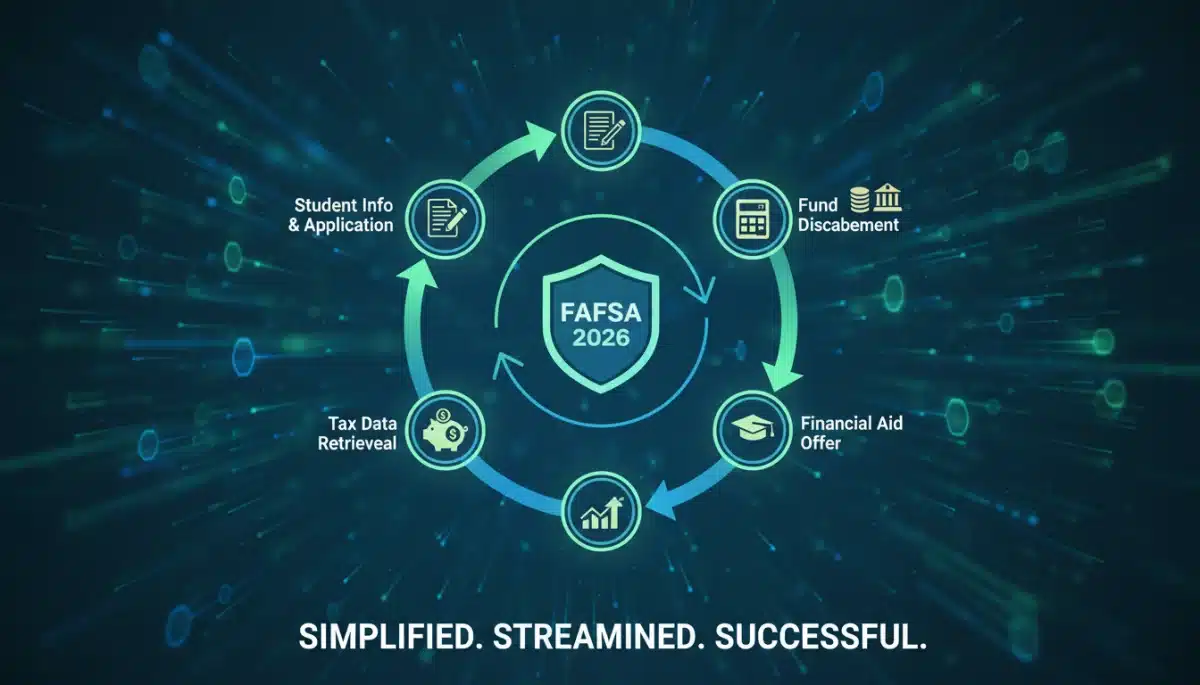
One of the most impactful changes for the 2026 FAFSA is the mandatory direct data exchange with the IRS, known as the FUTURE Act Direct Data Exchange (FA-DDX). This system replaces the previous IRS Data Retrieval Tool (DRT) and makes it compulsory for applicants, and their contributors (parents or spouses, if applicable), to consent to the direct transfer of their tax information from the IRS to the Department of Education. This consent is no longer optional; without it, the FAFSA cannot be processed, and students will not be eligible for federal student aid.
The FA-DDX aims to significantly reduce the burden of manually entering tax information, which was a frequent source of errors and delays. By automating this process, the Department of Education can ensure greater accuracy in income reporting and streamline the verification process for financial aid offices. This integration is a critical step towards a more efficient and error-free application experience.
Implications of Mandatory Data Exchange
- All applicants and contributors must provide consent for tax data retrieval.
- Reduces the need for manual tax data entry, minimizing errors.
- Expedites the FAFSA processing and verification timeline.
- Ensures greater accuracy in financial aid eligibility determinations.
While the mandatory nature of this data exchange might raise initial concerns for some, its long-term benefits in terms of simplification and accuracy are substantial. It represents a move towards a more integrated and reliable financial aid system.
Change 4: Modified Pell Grant Eligibility Criteria
The 2026 FAFSA updates bring significant modifications to Pell Grant eligibility, aiming to expand access to this crucial federal grant for low-income students. Under the new system, more students are expected to qualify for Pell Grants, and some may even receive the maximum award based on their family income and size, even if their Student Aid Index (SAI) is not zero. This particular change is designed to fulfill the original intent of the Pell Grant program: to provide a foundation of financial aid to students with the greatest financial need.
A key aspect of this modification is the introduction of minimum and maximum Pell Grant eligibility based on federal poverty levels. Students whose family income falls below a certain percentage of the federal poverty line will automatically qualify for a maximum Pell Grant, regardless of their SAI. Conversely, those whose income falls within another specified range will be guaranteed a minimum Pell Grant. This provides a clearer, more predictable pathway to receiving this vital aid.
New Pell Grant Calculation Factors
- Family size and adjusted gross income (AGI) are primary determinants.
- Direct linkage to federal poverty levels for automatic maximum or minimum awards.
- Removes the previous limitation based solely on a zero EFC.
- Potential for more students from middle-income families to receive some Pell Grant aid.
These changes to Pell Grant eligibility are poised to make a profound difference for countless students, making higher education more attainable and reducing the burden of student loan debt for those who need it most.
Change 5: Changes to Family Farm and Small Business Reporting
Previously, assets from family farms and small businesses were often excluded from the FAFSA calculation, particularly if the family primarily resided on the farm or if the business employed fewer than 100 full-time employees. The 2026 FAFSA updates remove these exclusions, meaning the net worth of family farms and small businesses will now be included in the calculation of the Student Aid Index (SAI). This change is likely to have a notable impact on families who own these types of assets.
The rationale behind this change is to provide a more comprehensive picture of a family’s financial strength, ensuring that all available resources are considered when determining financial need. While this might lead to a higher SAI for some families, potentially reducing their aid eligibility, it also aims to create a more equitable system where all forms of wealth are accounted for. Families affected by this change will need to accurately report the net worth of these assets on their FAFSA.
Reporting Requirements for Assets
- Net worth of family farms, including land, buildings, and equipment.
- Net worth of small businesses, regardless of the number of employees.
- Exclusions for primary residence no longer apply if it’s part of a farm.
- Accurate valuation of these assets will be crucial for the SAI calculation.
This revision emphasizes a broader definition of assets, requiring families to be more diligent in their financial reporting. It’s a significant shift that could alter aid eligibility for a specific segment of the applicant population, underscoring the importance of understanding the new FAFSA guidelines.
Change 6: New Terminology and Expanded Role of ‘Contributors’
The 2026 FAFSA introduces several new terms and redefines roles within the application process, most notably the concept of ‘contributors.’ Instead of just ‘parents,’ the FAFSA will now refer to ‘contributors,’ which can include parents, stepparents, or a spouse, depending on the applicant’s dependency status and family situation. Each contributor will receive an email invitation to complete their specific section of the FAFSA, requiring their consent for tax data retrieval via the FA-DDX.
This expanded definition aims to encompass all individuals who are financially responsible for the student, ensuring a complete and accurate financial picture. The language used throughout the form has also been simplified, moving away from complex financial jargon towards more accessible terms. This makes the application process less intimidating and easier to understand for all users, regardless of their financial literacy.
Key Terminology Updates
- Contributor: Replaces ‘parent’ or ‘spouse’ in certain contexts.
- Student Aid Index (SAI): Replaces Expected Family Contribution (EFC).
- FA-DDX: Replaces the IRS Data Retrieval Tool (DRT).
- Financial Aid Offer: Standardized term for aid packages from institutions.
These terminological adjustments are part of the broader effort to simplify the FAFSA and make it more transparent. Understanding these new terms will be essential for navigating the application effectively and communicating with financial aid offices.
Change 7: Impact on Divorced or Separated Parents
For students whose parents are divorced or separated, the 2026 FAFSA introduces a notable change in how parental information is reported. Previously, the FAFSA required financial information from the parent with whom the student lived for the majority of the past 12 months. Under the new guidelines, financial information will be required from the parent who provides the most financial support to the student, regardless of where the student primarily resides. This change is designed to provide a more accurate reflection of the family’s financial capacity to contribute to the student’s education.
This shift can have a significant impact on financial aid eligibility, as the income and assets of the financially supporting parent may differ substantially from the parent with whom the student lives. It necessitates careful consideration and clear communication within families to ensure the correct parent’s information is provided on the FAFSA. Failure to identify the correct ‘contributor’ could lead to delays or inaccuracies in aid determination.
Navigating Parental Reporting for Separated Families
- Identify the parent who provides the most financial support.
- That parent will be the primary ‘contributor’ on the FAFSA.
- Both parents may still need to provide consent for tax data retrieval if applicable.
- Communication between parents is crucial for accurate reporting.
This change underscores the importance of understanding the updated FAFSA rules, especially for families with complex parental situations. Adapting to this new requirement will be key to a smooth application process and accurate aid assessment.
| Key Change | Brief Description |
|---|---|
| SAI Replaces EFC | The Student Aid Index (SAI) replaces the Expected Family Contribution (EFC) for a more accurate financial need assessment. |
| Streamlined FAFSA | The form is significantly shorter, reduced from over 100 questions to approximately 36, simplifying the application process. |
| Direct IRS Data Exchange | Mandatory direct data transfer from the IRS to FAFSA streamlines income reporting and reduces errors. |
| Pell Grant Eligibility | Expanded criteria link Pell Grant awards to federal poverty levels, increasing access for low-income students. |
Frequently Asked Questions About 2026 FAFSA Updates
The main purpose of the FAFSA Simplification Act is to streamline the financial aid application process, expand federal student aid eligibility, and provide a more accurate and equitable assessment of a student’s financial need. This aims to make higher education more accessible.
The SAI differs from the EFC by being a more comprehensive measure of financial need. Unlike the EFC, the SAI can be a negative number, indicating a higher level of need, and it removes the number of family members in college from its calculation, among other changes.
Yes, the IRS Direct Data Exchange (FA-DDX) is mandatory for the 2026 FAFSA. Applicants and all contributors (parents/spouses) must provide consent for their tax information to be directly transferred from the IRS. Without this consent, the FAFSA cannot be processed.
Yes, more students are expected to be eligible for Pell Grants under the new 2026 FAFSA rules. The updated criteria link Pell Grant awards more directly to federal poverty levels, potentially allowing a broader range of low-income students to qualify for maximum or minimum awards.
For divorced or separated parents, the 2026 FAFSA will now require financial information from the parent who provides the most financial support to the student, rather than the parent with whom the student primarily resides. This change aims for a more accurate reflection of financial capability.
Conclusion
The 2026 FAFSA Updates represent a monumental shift in the landscape of federal student aid, designed to make the journey to higher education more accessible and less confusing for American families. From replacing the EFC with the more intuitive SAI to streamlining the application form and mandating direct data exchange with the IRS, these changes aim to broaden eligibility and simplify the process. While some adjustments, like the inclusion of family farm and small business assets, and the new approach for divorced parents, may require careful attention, the overarching goal is to foster a more equitable and efficient system. Staying informed and preparing for these modifications will be crucial for college-bound students to maximize their financial aid opportunities and confidently pursue their academic dreams. The future of student aid is evolving, and understanding these key changes is the first step towards unlocking educational potential.