Rethinking Standardized Testing: Alternative Assessment Models 2025

Anúncios
Leading educational institutions in the US are increasingly adopting innovative alternative assessment models to move beyond the limitations of standardized testing, offering a more nuanced and equitable measure of student achievement by 2025.
The conversation around education in the United States is constantly evolving, and at its heart lies a fundamental question: how do we truly measure what students know and can do? For decades, standardized testing has been the dominant answer, yet its limitations are becoming increasingly apparent. This has fueled a significant push towards alternative assessment models, with several innovative approaches gaining considerable traction across the US by 2025. This article explores three such models that are reshaping how we evaluate student learning, offering a more holistic and equitable view of academic progress.
Anúncios
The evolving landscape of student assessment
Traditional standardized tests have long been a cornerstone of the American education system. They were designed to provide a uniform measure of student achievement and school accountability. However, their critics argue that these tests often fail to capture the full spectrum of student capabilities, penalize diverse learners, and narrow the curriculum to testable subjects.
Anúncios
The shift towards alternative assessment methods is not merely a trend; it’s a response to a growing understanding of learning and development. Educators and policymakers are recognizing the need for assessments that are more authentic, engaging, and reflective of real-world skills. This evolution is driven by a desire to foster deeper learning, critical thinking, creativity, and collaboration – skills often overlooked by multiple-choice exams.
This movement is also about equity. Standardized tests have historically been criticized for exacerbating achievement gaps, often correlating with socioeconomic status and cultural background. Alternative models aim to mitigate these biases by offering diverse ways for students to demonstrate their knowledge and growth.
Project-based learning assessments: real-world application
One of the most prominent alternative assessment models gaining traction is project-based learning (PBL) assessments. This approach moves away from rote memorization and towards hands-on, inquiry-driven projects that require students to apply knowledge and skills to solve complex problems or create tangible products. PBL assessments inherently integrate learning with evaluation, making the assessment process more meaningful for students.
In a PBL assessment, students might work individually or in teams over an extended period, culminating in a presentation, a prototype, a research paper, or a performance. The assessment is not just about the final product but also about the process, including research, collaboration, critical thinking, and problem-solving. This method encourages deeper engagement and provides a more authentic demonstration of understanding.
Benefits of project-based learning assessments
- Deeper understanding: Students engage with content in a more meaningful way, leading to better retention and application of knowledge.
- Skill development: Fosters critical thinking, collaboration, communication, and creativity.
- Authenticity: Mirrors real-world challenges and problem-solving scenarios, preparing students for future careers and life.
- Student engagement: Increases motivation and ownership over learning by allowing students to pursue topics of interest.
PBL assessments often involve rubrics that clearly define expectations for both the process and the product. These rubrics evaluate not only content knowledge but also skills like teamwork, research methodology, and presentation abilities. This comprehensive evaluation provides a richer picture of student capabilities than a single test score.
Digital portfolios: showcasing growth and diverse talents
Another powerful alternative assessment model rapidly gaining ground is the use of digital portfolios. Unlike a single snapshot provided by a standardized test, a digital portfolio is a curated collection of student work over time, demonstrating growth, mastery, and individual talents. These portfolios can include essays, creative writing, artwork, multimedia projects, presentations, reflections, and even performance recordings.
Digital portfolios empower students to take ownership of their learning journey. They learn to select, organize, and reflect on their best work, articulating their learning process and achievements. This meta-cognitive process is invaluable for developing self-awareness and critical thinking skills. For educators, digital portfolios offer a comprehensive view of a student’s progress, strengths, and areas for development, far beyond what a test score can convey.
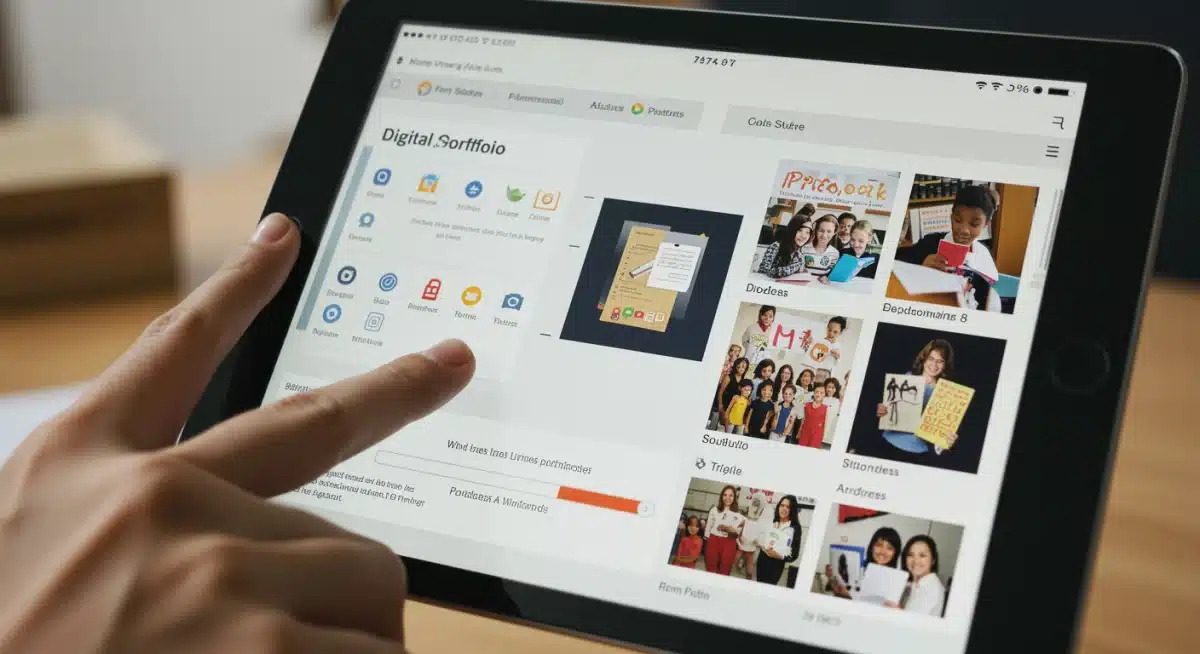
Components of effective digital portfolios
- Diverse artifacts: A range of work demonstrating different skills and knowledge areas.
- Student reflections: Critical self-analysis of learning, challenges, and growth.
- Goals and evidence: Clear connections between student work and learning objectives.
- Feedback integration: Opportunities for teachers and peers to provide constructive comments.
The adoption of digital platforms has made creating and managing these portfolios more accessible and interactive. They can be shared with parents, future educators, or even potential employers, offering a dynamic and personalized representation of a student’s educational journey and accomplishments. This model aligns perfectly with a personalized learning approach, recognizing and celebrating individual pathways to success.
Performance-based assessments: demonstrating skills in action
Performance-based assessments require students to demonstrate their knowledge and skills by completing a task or creating a product. These assessments are designed to measure a student’s ability to apply what they’ve learned in a practical context, often simulating real-world scenarios. Examples include science experiments, dramatic performances, debates, musical recitals, or solving a complex mathematical problem using various tools.
The key characteristic of performance-based assessments is that they are not about recalling facts but about doing. They assess higher-order thinking skills, problem-solving, and the ability to synthesize information. These assessments often involve observation by the teacher, who evaluates the student’s process as well as their final outcome, using detailed rubrics to ensure consistency and fairness.
This method is particularly valuable for subjects that require practical application, such as vocational training, arts, and sciences. It ensures that students are not just theoretically understanding concepts but can actually perform tasks related to them. The feedback provided is often immediate and specific, allowing students to understand where they excelled and where they need to improve.
Advantages of performance-based assessments
- Authentic demonstration: Students show what they can do rather than what they can recall.
- Higher-order thinking: Encourages analysis, synthesis, evaluation, and creation.
- Skill integration: Often requires the use of multiple skills simultaneously.
- Motivation: Can be highly engaging and motivating for students who thrive on hands-on activities.
As schools look to prepare students for a rapidly changing job market, the emphasis on demonstrable skills becomes paramount. Performance-based assessments provide a direct way to evaluate these essential competencies, moving beyond the narrow confines of traditional testing to a more comprehensive skill assessment.
Challenges and opportunities in implementation
While the benefits of alternative assessment models are clear, their widespread implementation comes with challenges. One primary concern is the time and resources required for teachers to design, administer, and grade these assessments. Developing robust rubrics, providing personalized feedback, and managing diverse projects demand significant professional development and support.
Another challenge lies in comparability and standardization. How do states and districts compare student achievement across schools and regions if each school is using different assessment methods? This is where innovative approaches to aggregating and interpreting data from alternative assessments become crucial. Some states are exploring statewide portfolio systems or common performance tasks that allow for some level of comparability while retaining local flexibility.
Despite these hurdles, the opportunities are immense. Alternative assessments can lead to more equitable and inclusive educational environments where every student has the chance to demonstrate their strengths. They can foster a culture of continuous learning and improvement, shifting the focus from ‘teaching to the test’ to ‘teaching for understanding and application.’ By investing in teacher training, developing clear guidelines, and leveraging technology, schools can effectively integrate these models.
The push for these models is not just about changing how we test; it’s about fundamentally rethinking what we value in education. It’s about recognizing that true learning is complex, multifaceted, and extends far beyond what can be captured in a single bubble sheet. The ongoing dialogue among educators, policymakers, and communities is vital to navigating these changes and building a more effective and equitable assessment system for all.
Looking ahead: the future of assessment in the US
The increased adoption of project-based learning, digital portfolios, and performance-based assessments signals a significant paradigm shift in US education. By 2025, these alternative assessment models are expected to become more mainstream, integrated into daily classroom practices rather than being standalone experiments. This integration will require ongoing collaboration among stakeholders to ensure consistency, validity, and reliability across diverse educational settings.
The future of assessment will likely involve a blend of approaches, where traditional tests might still play a role for certain purposes, but they will be complemented and often superseded by more authentic and comprehensive methods. Technology will continue to be a key enabler, providing platforms for digital portfolios, tools for creating interactive projects, and sophisticated analytics to track student progress.
Ultimately, the goal is to create an assessment system that truly serves students, providing them with meaningful feedback, fostering their growth, and preparing them for a future that demands critical thinking, creativity, and adaptability. The journey to fully embrace these alternative models is complex, but the potential rewards for students, educators, and society are profound.
| Assessment Model | Key Benefit |
|---|---|
| Project-Based Learning | Fosters deeper understanding and real-world skill application. |
| Digital Portfolios | Showcases student growth, diverse talents, and self-reflection over time. |
| Performance-Based Assessments | Measures practical application of knowledge and higher-order thinking skills. |
| Holistic Evaluation | Provides a more comprehensive and equitable view of student capabilities. |
Frequently asked questions about alternative assessments
Traditional standardized tests are often criticized for failing to assess higher-order thinking skills, promoting rote memorization, and narrowing curricula. They can also create undue stress for students and teachers, often showing biases that disadvantage certain demographic groups, leading to an incomplete picture of student potential and progress.
Project-based learning (PBL) assessments integrate the learning and assessment processes. Unlike traditional projects that might be an add-on, PBL is the primary instructional method, focusing on complex, real-world problems that require sustained inquiry and collaboration, culminating in a public product or presentation that demonstrates deep understanding.
While digital portfolios offer a rich, holistic view of student learning and growth, replacing all traditional grading entirely might be challenging due to existing accountability systems. They are most effective when used as a significant component of a balanced assessment system, complementing other methods to provide a comprehensive evaluation.
Performance-based assessments excel at measuring a student’s ability to apply knowledge and skills in practical contexts. They assess critical thinking, problem-solving, creativity, communication, and collaboration. These assessments move beyond mere recall, focusing on how students use what they’ve learned to accomplish specific tasks or create products.
Key challenges include the significant time and resources required for teacher training and development of robust rubrics. Ensuring comparability across different schools and districts, managing data effectively, and addressing the logistical complexities of diverse assessment methods are also major hurdles that need careful planning and innovative solutions.
Conclusion
The movement toward alternative assessment models represents a critical evolution in American education. As we approach 2025, the increased adoption of project-based learning, digital portfolios, and performance-based assessments signifies a commitment to more authentic, equitable, and comprehensive evaluations of student learning. While challenges in implementation and scalability remain, the benefits of these innovative approaches—fostering deeper understanding, cultivating essential skills, and providing a more holistic view of student capabilities—are undeniable. This shift promises to better prepare students for the complexities of the 21st century, moving beyond the limitations of standardized tests to truly empower learners.