Online vs. Traditional Degrees 2026: Career Data in US
Anúncios
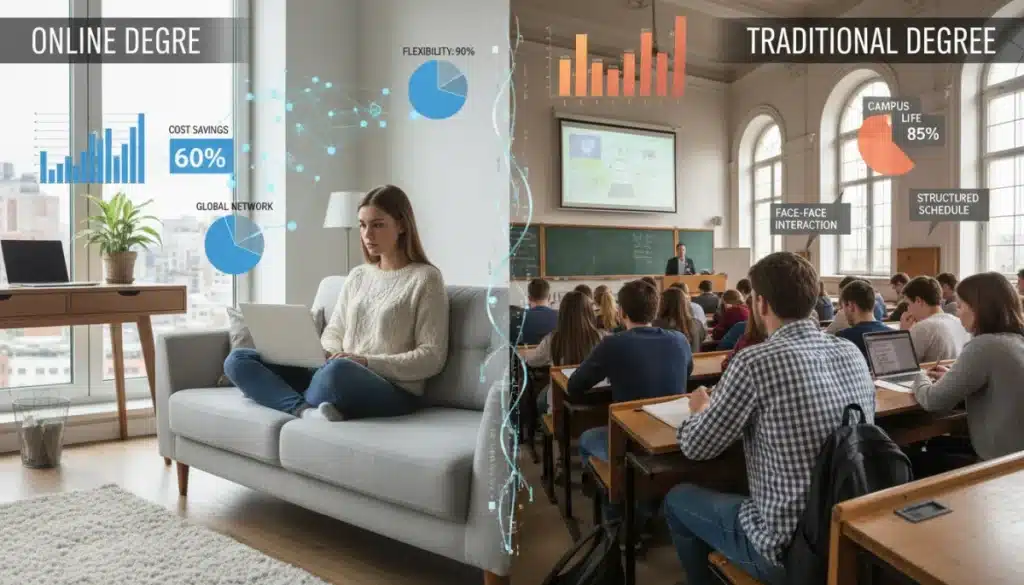
A data-backed comparison reveals that both online and traditional degrees offer distinct advantages for career advancement in 2026, depending on individual student needs and professional goals.
The landscape of higher education is continually evolving, and in 2026, the discussion around online vs. traditional degrees remains more pertinent than ever. As students and professionals navigate their educational paths, understanding the nuanced differences and long-term implications of each option is crucial for making informed decisions about career advancement in the United States.
Anúncios
The evolving landscape of higher education in 2026
Higher education in the US has undergone significant transformations, accelerated by technological advancements and shifts in workforce demands. The traditional model, characterized by on-campus learning and a fixed schedule, has been challenged by the rise of online programs, which offer unparalleled flexibility and accessibility. This evolution has profound implications for how degrees are perceived by employers and their actual impact on career trajectories.
Anúncios
Technological integration and learning modalities
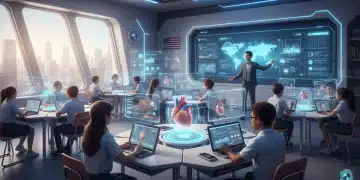
The integration of advanced learning technologies has refined online education, making it more interactive and engaging than ever before. Virtual reality, AI-powered tutoring, and sophisticated online collaboration tools are becoming standard, blurring the lines between physical and virtual classrooms. These tools enhance the learning experience, allowing for personalized pacing and diverse instructional methods.
- Adaptive learning platforms: Tailor content to individual student needs and learning styles.
- Virtual labs and simulations: Provide practical experience in fields like engineering and healthcare without physical presence.
- AI-driven feedback: Offers immediate and personalized insights on assignments and progress.
- Global collaboration tools: Connect students with peers and experts worldwide, fostering diverse perspectives.
Meanwhile, traditional institutions are also adopting these technologies to enrich their on-campus offerings, often blending in-person instruction with digital resources. This hybrid approach aims to combine the best of both worlds, providing students with both face-to-face interaction and digital flexibility. The goal is to prepare graduates for a workforce that increasingly demands digital literacy and adaptability.
Ultimately, the choice between online and traditional degrees in 2026 is less about one being inherently superior and more about which model best aligns with an individual’s learning style, life circumstances, and career aspirations. Both pathways are continually adapting to provide rigorous and relevant education.
Career advancement: perceptions and realities
When considering career advancement, the perceived value of online versus traditional degrees often varies. Historically, traditional degrees held a stronger reputation, but this perception is rapidly shifting. Employers in 2026 are increasingly recognizing the legitimacy and rigor of online programs, especially those from reputable institutions.
Data from recent employment surveys indicates a growing acceptance of online credentials. Many employers now prioritize skills, experience, and the institution’s accreditation over the mode of delivery. This shift is particularly evident in industries that value adaptability and technological proficiency, where online graduates often demonstrate these qualities through their learning journey.
Employer perspectives on degree types
While some traditional sectors might still lean towards candidates with on-campus experience, a significant majority of companies, especially those in tech, healthcare, and business, view online degrees favorably. What matters most is the quality of the program and the competencies the graduate brings to the role.
- Accreditation: Programs from regionally accredited institutions are universally respected, regardless of delivery method.
- Skill alignment: Employers seek candidates whose skills directly match job requirements, often developed through practical online coursework.
- Networking opportunities: Both online and traditional programs offer networking, though the methods differ (virtual forums vs. on-campus events).
- Soft skills: Online learners often develop strong self-discipline, time management, and digital communication skills, highly valued in the modern workplace.
The reality is that career advancement in 2026 is less about the ‘how’ of your degree and more about the ‘what’ and ‘who’ – what you learned, what you can do, and what reputation your institution carries. Online degrees from well-regarded universities are now on par with their traditional counterparts in many professional fields, offering equal opportunities for growth and promotion.
Flexibility and accessibility: a student-centric view
One of the most compelling advantages of online degrees is the unparalleled flexibility and accessibility they offer. This is particularly beneficial for non-traditional students, working professionals, and individuals with family commitments or geographical constraints. Online programs allow students to pursue higher education without disrupting their lives.
Traditional degrees, while offering a structured campus experience, can be restrictive for many. Fixed schedules, geographical relocation, and on-campus residency requirements can be significant barriers. Online learning removes these obstacles, making education attainable for a broader demographic.
Balancing work, life, and studies
For many, the ability to balance work, family, and studies is not just a convenience but a necessity. Online programs empower students to create their own learning schedules, study from anywhere, and progress at a pace that suits their individual circumstances. This flexibility can lead to higher completion rates and a more positive learning experience.
- Asynchronous learning: Allows students to access course materials and participate in discussions at any time.
- Geographic independence: Eliminates the need for relocation, opening access to top universities regardless of location.
- Work-study balance: Enables students to maintain employment while pursuing their degree, reducing financial strain.
- Diverse learning environments: Caters to various learning styles, from self-paced to highly interactive virtual classrooms.
While traditional programs offer a rich campus life and face-to-face interaction, the sacrifices required are not always feasible or desirable for every student. The accessibility of online education ensures that intellectual growth and career advancement are not limited by personal circumstances, making it a powerful equalizer in higher education.
Financial implications: costs and returns
The financial aspect is a critical factor in choosing between online and traditional degrees. While tuition fees for online programs can sometimes be comparable to or even higher than traditional ones, the overall cost of attendance often favors online education due to reduced ancillary expenses.
Traditional degrees typically involve significant costs beyond tuition, such as on-campus housing, meal plans, transportation, and various campus fees. These expenses can quickly accumulate, making the total cost of a traditional degree substantially higher for many students.
Analyzing the total cost of attendance
When evaluating the financial commitment, it’s essential to look beyond just tuition. Online students often save on living expenses, commuting costs, and may even continue working full-time, offsetting educational costs. These savings can make a significant difference in a student’s overall financial burden and post-graduation debt.
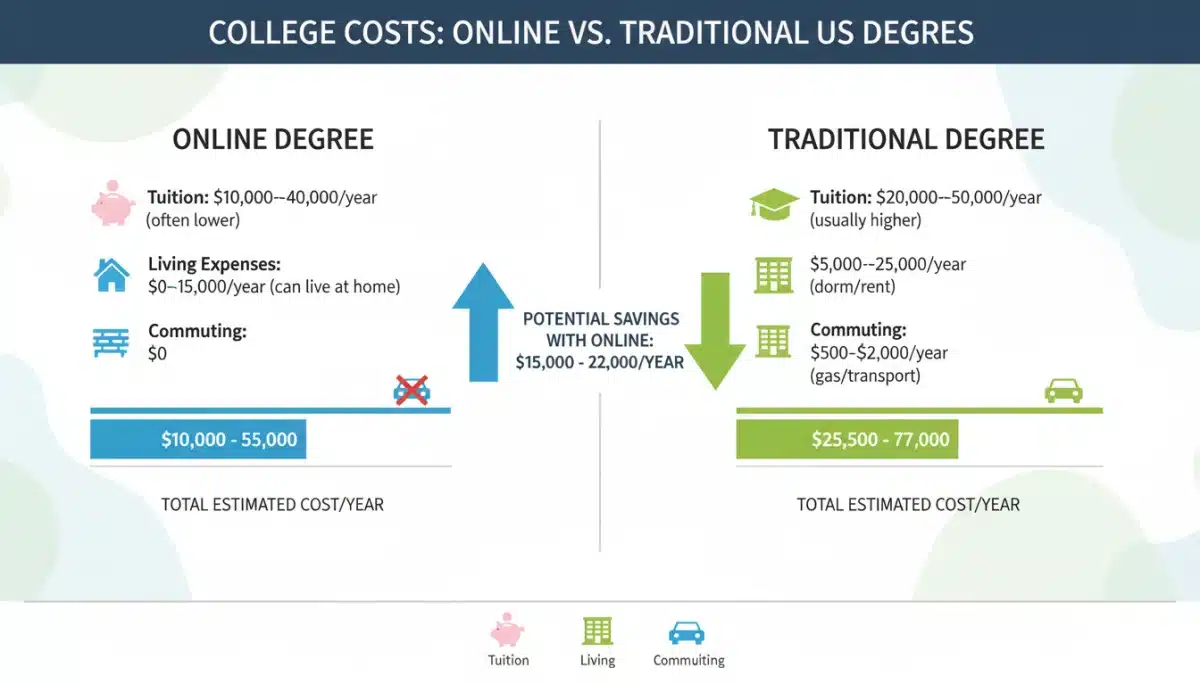
- Tuition fees: Can vary widely, but often online programs offer competitive rates, especially from public institutions.
- Living expenses: Online students typically save on rent, utilities, and food costs associated with campus living.
- Commuting and transportation: Eliminated for online learners, saving significant amounts over the course of a degree.
- Opportunity cost: Online flexibility allows students to maintain employment, reducing lost income during studies.
The return on investment (ROI) for both degree types can be high, provided the program is reputable and aligns with career goals. However, the lower overall cost of online degrees can lead to a faster and more favorable ROI, as graduates may start their careers with less debt. This financial advantage is a major draw for many students seeking a practical path to career advancement.
Networking and social engagement: a comparative look
Networking and social engagement are vital components of the college experience and can significantly impact career development. Traditional degrees excel in providing face-to-face opportunities for interaction with peers, professors, and industry professionals through campus events, clubs, and informal gatherings.
Online degrees, while different in their approach, have also evolved to offer robust networking and social engagement opportunities. Modern online platforms are designed to foster community, collaboration, and professional connections, albeit through virtual means.
Building connections in virtual and physical spaces
In the digital age, networking extends far beyond physical proximity. Online students engage in discussion forums, virtual study groups, and professional social networks. Many online programs also incorporate virtual career fairs, guest speaker series, and alumni networking events, providing valuable connections.
- Virtual collaboration: Group projects and online discussions mimic real-world team environments.
- Professional platforms: LinkedIn and specialized online communities offer direct access to industry leaders and peers.
- Hybrid events: Some online programs offer optional in-person meetups or conferences to foster stronger bonds.
- Alumni networks: Many universities integrate online students into their broader alumni networks, providing lifelong connections.
While the spontaneity of traditional campus interactions might be unique, online programs cultivate a different kind of networking – one that is often more intentional, globally diverse, and digitally fluent. Both models ultimately aim to equip students with the connections necessary for career success, adapting to the evolving nature of professional relationships in 2026.
Future outlook: trends shaping higher education
Looking ahead to 2026 and beyond, several trends are poised to further shape the landscape of higher education, influencing the dynamic between online and traditional degrees. The demand for flexible, skills-based education is growing, driven by rapid technological changes and evolving job markets.
Hybrid models are expected to become even more prevalent, allowing institutions to offer the best of both worlds: the structure and community of traditional campuses combined with the flexibility and accessibility of online learning. This blending of approaches will cater to a wider range of student needs and preferences.
Emerging educational models and technologies
Micro-credentials, bootcamps, and competency-based education are gaining traction as alternatives or complements to traditional degrees. These shorter, focused programs allow individuals to quickly acquire specific skills demanded by the industry, offering agile pathways to career advancement.
- Personalized learning paths: AI and data analytics will enable highly customized educational journeys.
- Lifelong learning: The concept of continuous education will become standard, with degrees acting as foundational stepping stones.
- Globalized education: Online platforms will further break down geographical barriers, fostering international collaboration and learning.
- Skills-based hiring: Employers will increasingly prioritize demonstrated skills and competencies over traditional credentials alone.
The future of higher education in the US is one of diversification and innovation. Both online and traditional degrees will continue to evolve, adapting to new technologies and societal demands. The ultimate goal remains to prepare students for successful and fulfilling careers in an increasingly complex and dynamic world, ensuring that education remains a powerful tool for personal and professional growth.
| Key Aspect | Description |
|---|---|
| Career Perception | Growing employer acceptance of online degrees, focusing on skills and accreditation. |
| Flexibility | Online degrees offer unmatched scheduling and location flexibility for diverse students. |
| Financial Costs | Online education often leads to lower overall costs due to reduced living and commuting expenses. |
| Networking | Both offer networking, with online fostering virtual, global connections. |
Frequently asked questions about degrees in 2026
Yes, increasingly so. Employers in 2026 prioritize skills, relevant experience, and the accreditation of the institution over the mode of degree delivery. Many reputable online programs are now viewed on par with their traditional counterparts, particularly in tech and business fields.
While tuition can be similar, online degrees generally incur lower overall costs due to reduced or eliminated expenses for housing, meal plans, and daily commuting. This often leads to less student debt and a potentially higher return on investment post-graduation.
Online degrees can significantly boost career advancement, especially for working professionals seeking to upskill or reskill without career interruption. The flexibility allows for continuous employment, and the acquired skills are directly applicable to career growth in many industries.
Absolutely. Modern online programs incorporate virtual forums, group projects, and digital networking events. Many also integrate students into robust alumni networks, allowing for extensive professional connections that are often globally diverse and digitally fluent, crucial for today’s job market.
Consider the rise of hybrid learning models, micro-credentials, and skills-based education. The future emphasizes lifelong learning and personalized paths, so choose a program that offers flexibility and equips you with highly sought-after, adaptable skills for evolving job markets.
Conclusion
In conclusion, the choice between online and traditional degrees in 2026 is no longer a simple dichotomy but a complex decision influenced by individual circumstances, career goals, and evolving educational trends. Both pathways offer distinct advantages for career advancement in the US, with online degrees providing unparalleled flexibility and often lower overall costs, while traditional degrees offer a rich, immersive campus experience. Ultimately, the most effective path is one that aligns with a student’s learning style, financial situation, and professional aspirations, ensuring a strong foundation for future success in a dynamic workforce.