Child Tax Credit 2026: What Families Can Expect

Anúncios
The Child Tax Credit in 2026 is set for crucial legislative updates, potentially altering eligibility, benefit amounts, and the overall financial landscape for American families, making it essential to stay informed about these impending changes.
As we approach 2026, the landscape of family benefits, particularly the Child Tax Credit in 2026: What Families Can Expect from Recent Legislative Updates, remains a topic of significant interest and discussion among American households. Understanding these potential shifts is not just about tax planning; it’s about securing the financial well-being of millions of children and their caregivers across the nation. This comprehensive guide will delve into the anticipated changes, helping you navigate the future of this vital support program.
Anúncios
Understanding the Child Tax Credit’s Evolution
The Child Tax Credit (CTC) has a rich history of evolution, reflecting changing economic conditions and societal needs. Since its inception, this credit has aimed to provide financial relief to families, helping to offset the costs associated with raising children. However, its structure and benefit levels have been subject to frequent legislative adjustments, often leading to uncertainty for parents.
Anúncios
Historically, the CTC has seen various iterations, from its initial introduction to the significant enhancements under the American Rescue Plan. Each change has brought both opportunities and challenges, influencing how families budget, save, and invest in their children’s futures. Keeping track of these historical precedents is crucial for understanding the current trajectory and anticipating what 2026 might bring.
Key Historical Milestones of the CTC
- 1997 Creation: The CTC was initially established at $400 per child, providing a non-refundable credit to help families.
- Early 2000s Expansions: Subsequent legislation gradually increased the credit amount and expanded eligibility, recognizing the growing financial pressures on families.
- 2017 Tax Cuts and Jobs Act (TCJA): This act significantly increased the CTC to $2,000 per child and made a portion of it refundable, up to $1,400.
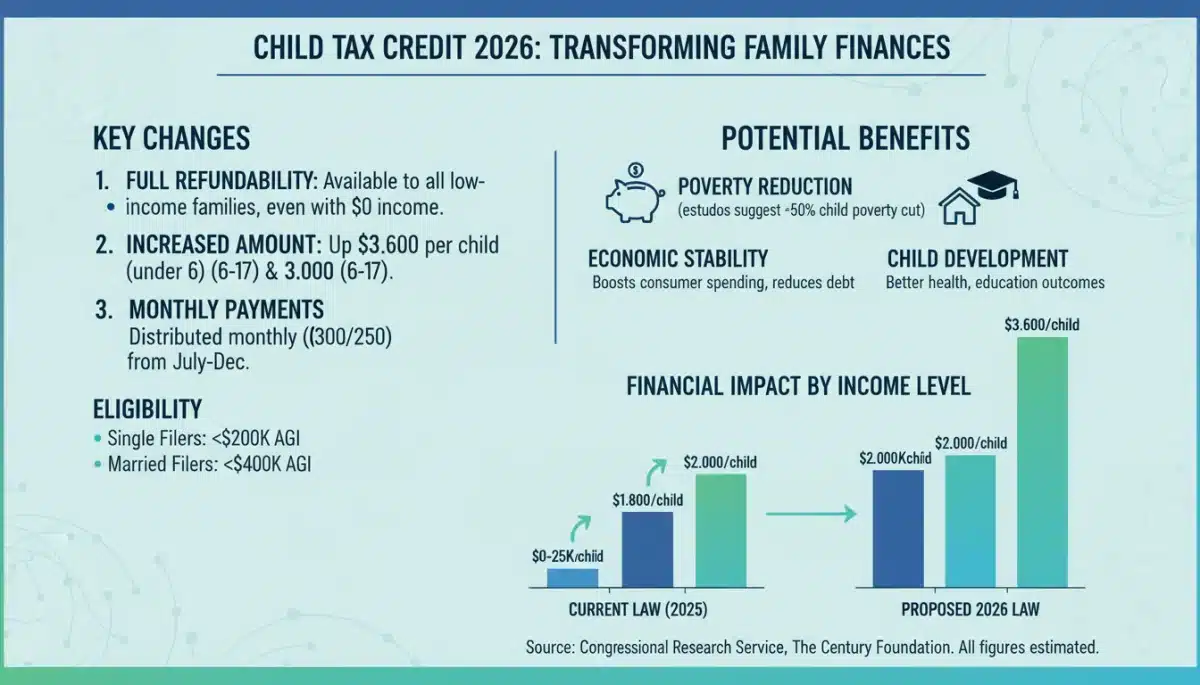
- 2021 American Rescue Plan (ARP): A temporary but substantial expansion increased the credit to $3,600 for children under six and $3,000 for those aged six to seventeen, making it fully refundable and allowing for advance monthly payments.
The temporary nature of the ARP’s expansions means that without further legislative action, the CTC is set to revert to its pre-2021 structure. This potential rollback forms the core of the discussion surrounding the Child Tax Credit in 2026, prompting families to prepare for significant adjustments.
Understanding the historical context of the Child Tax Credit is vital for appreciating the current legislative debates. Each past modification has aimed to address specific economic challenges or social goals, shaping the program into what it is today. As we look towards 2026, these historical patterns offer clues to the types of changes lawmakers might consider, whether they lean towards expansion or a more conservative approach.
Recent Legislative Updates and Proposals for 2026
The period leading up to 2026 is marked by intense legislative activity and a variety of proposals concerning the Child Tax Credit. Lawmakers are engaged in discussions that could dramatically reshape the credit’s reach and impact. These debates often center on balancing fiscal responsibility with the pressing needs of American families, particularly in the face of ongoing economic fluctuations.
Several key proposals are currently on the table, each with different implications for families. Some proposals advocate for extending the enhancements of the American Rescue Plan, citing the proven benefits of increased financial support for children and reduced poverty rates. Others suggest more modest adjustments, focusing on targeted relief or maintaining the pre-2021 structure to control government spending.
Key Legislative Debates
- Full Refundability: A major point of contention is whether the CTC should remain fully refundable, allowing low-income families with little or no tax liability to receive the full benefit.
- Credit Amount: Discussions include whether to maintain the expanded credit amounts ($3,000/$3,600) or revert to the pre-2021 $2,000 limit.
- Advance Payments: The convenience and effectiveness of monthly advance payments, a feature of the ARP, are also being debated for potential reintroduction.
- Income Thresholds: Lawmakers are considering adjustments to the income phase-out thresholds, which determine eligibility for the credit, to target specific income brackets.
The outcome of these legislative debates will directly influence the final structure of the Child Tax Credit in 2026. Families should closely monitor news and policy updates from Congress and the Treasury Department, as these proposals can shift rapidly. Advocacy groups and economic think tanks are also playing a significant role, providing data and arguments to sway public opinion and legislative decisions.
The legislative landscape is dynamic, with various stakeholders pushing for different outcomes. From bipartisan efforts to more partisan divides, the future of the CTC hinges on complex negotiations. Staying informed about these proposals is essential for families to anticipate changes and plan accordingly for their financial future.
Eligibility Requirements: Who Qualifies in 2026?
One of the most critical aspects of the Child Tax Credit for families is understanding who qualifies for the benefit. The eligibility criteria for the Child Tax Credit in 2026 will largely depend on the legislative outcomes of the ongoing debates. However, certain fundamental requirements are likely to remain consistent, while others may see significant modifications.
Typically, eligibility for the CTC revolves around the child’s age, their relationship to the taxpayer, residency, and the taxpayer’s income. The specifics of these criteria, particularly income thresholds and the age limit for qualifying children, are often the subject of legislative changes. Families need to be aware of these potential adjustments to accurately assess their eligibility.
Standard Eligibility Criteria (Pre-ARP Baseline)
- Child’s Age: The child must be under the age of 17 at the end of the tax year.
- Relationship Test: The child must be your son, daughter, stepchild, foster child, brother, sister, half-brother, half-sister, stepbrother, stepsister, or a descendant of any of them.
- Residency Test: The child must have lived with you for more than half of the tax year.
- Support Test: The child must not have provided more than half of their own support for the year.
- Joint Return Test: If the child is married, they cannot file a joint return for the year (unless filed only to claim a refund of withheld income tax or estimated tax paid).
- Citizenship Test: The child must be a U.S. citizen, U.S. national, or U.S. resident alien.
Income limitations are another crucial factor. Under pre-ARP rules, the credit began to phase out for single filers with a modified adjusted gross income (MAGI) over $200,000, and for married couples filing jointly with a MAGI over $400,000. These thresholds could be altered in 2026, impacting higher-income families’ access to the credit. The debate over full refundability also directly affects low-income families, determining whether they can receive the full credit even if they have little or no federal income tax liability.
Families are encouraged to use the IRS’s online tools and consult with tax professionals as 2026 approaches to get the most accurate and up-to-date information on eligibility. The specific details of the legislative updates will be paramount in determining who ultimately qualifies for the Child Tax Credit in 2026.
Potential Impact on Family Finances and the Economy
The structure of the Child Tax Credit in 2026 will have profound implications for both individual family finances and the broader U.S. economy. For families, the credit can be a critical lifeline, helping to cover essential expenses like food, housing, childcare, and educational supplies. Changes to the credit’s amount, refundability, or payment frequency can significantly alter household budgets and financial stability.
If the credit reverts to its pre-2021 structure, many families, especially those with lower incomes, could experience a reduction in their annual financial support. This could lead to increased financial strain, potentially impacting children’s well-being and development. Conversely, an extension or expansion of the credit could continue to alleviate poverty and boost economic security for millions.
Economic Consequences of CTC Changes
- Poverty Reduction: Expanded CTC has been shown to significantly reduce child poverty rates, while a rollback could reverse these gains.
- Consumer Spending: Direct financial aid to families often translates into increased consumer spending, stimulating local economies.
- Child Development: Financial stability provided by the CTC can lead to better outcomes for children in terms of health, education, and future earning potential.
- Workforce Participation: The design of the credit, particularly its refundability and phase-in rules, can influence parents’ decisions regarding work and childcare.
Beyond individual households, the aggregate effect of the Child Tax Credit on the national economy is substantial. Studies have indicated that the expanded CTC under the American Rescue Plan injected billions into the economy, supporting businesses and employment. Any future changes, whether an expansion or contraction, will likely reverberate through various economic sectors, influencing everything from retail sales to housing markets.
Economists and policymakers will be closely watching the impact of the Child Tax Credit in 2026 on key indicators such as poverty rates, income inequality, and overall economic growth. The decisions made regarding this credit are not just about tax policy; they are about shaping the economic future of the nation and its youngest citizens.
Preparing for Changes: Tips for Families
Given the uncertainty surrounding the Child Tax Credit in 2026, proactive preparation is key for families. Understanding potential scenarios and taking steps now can help mitigate any negative financial impacts or maximize future benefits. This involves a combination of financial planning, staying informed, and potentially adjusting household budgets.
One of the first steps is to review your current financial situation and understand how the CTC currently affects your budget. If you received the expanded credit, consider how a reduction might impact your ability to cover essential expenses. Creating a contingency budget that accounts for different CTC outcomes can provide a sense of security and a clear action plan.
Actionable Steps for Families
- Monitor Legislative News: Regularly check official government sources, reputable news outlets, and tax advisory sites for updates on CTC legislation.
- Review Your Tax Records: Understand your eligibility under both current and potential future CTC rules.
- Adjust Your Budget: If a reduction in the CTC is likely, start identifying areas where you can save or reallocate funds.
- Consult a Tax Professional: A qualified tax advisor can provide personalized guidance based on your specific financial situation and the latest legislative changes.
- Explore Other Benefits: Research other federal, state, or local benefits and assistance programs that your family might qualify for.
Families should also consider adjusting their tax withholding. If the CTC amount changes, your tax liability might shift, making it prudent to update your W-4 form with your employer. This can help prevent unexpected tax bills or ensure you’re receiving the correct amount throughout the year. The goal is to ensure that you are not caught off guard by any changes and that your family’s financial health remains stable.
By taking these preparatory steps, families can position themselves to adapt effectively to whatever form the Child Tax Credit in 2026 ultimately takes. Proactive planning is the best defense against financial uncertainty and the best way to ensure continued support for your children.
Advocacy and the Future of the CTC
The future of the Child Tax Credit in 2026 is not solely in the hands of legislators; public advocacy plays a significant role in shaping policy outcomes. Numerous organizations, economists, and everyday citizens are actively engaging in the debate, highlighting the importance of the CTC for family well-being and economic stability. Understanding these advocacy efforts can provide insight into the potential direction of the credit.
Advocacy groups often conduct research, publish reports, and organize campaigns to demonstrate the impact of the CTC on families and children. These efforts aim to inform policymakers and the public about the benefits of a robust credit, such as reductions in child poverty, improved health outcomes, and enhanced educational opportunities. Their voices are crucial in influencing legislative priorities.
Key Advocacy Focus Areas
- Poverty Alleviation: Advocates frequently emphasize the CTC’s role in lifting millions of children out of poverty, particularly the fully refundable version.
- Economic Stimulus: Arguments are often made about how the CTC boosts local economies through increased consumer spending.
- Long-Term Benefits: Highlighting the long-term societal benefits of investing in children, such as a more educated and productive future workforce.
- Bipartisan Solutions: Efforts are often made to find common ground and develop bipartisan solutions that ensure a stable and effective CTC.
Individuals also have a voice in this process. Contacting elected officials, participating in surveys, and engaging in community discussions can contribute to the broader conversation about the CTC. Personal stories of how the credit has impacted families can be particularly powerful in conveying its importance to lawmakers. The collective weight of these voices can help sway legislative decisions towards policies that better support families.
As 2026 approaches, the interplay between legislative proposals, economic data, and public advocacy will determine the final form of the Child Tax Credit. Staying engaged with these discussions is not just about understanding policy; it’s about participating in shaping a crucial benefit for American families.
Navigating Tax Season with CTC Changes
The impending changes to the Child Tax Credit in 2026 will undoubtedly influence how families navigate future tax seasons. Understanding these potential shifts well in advance is crucial for accurate tax filing and maximizing any eligible benefits. The complexity of tax law means that even minor alterations to the CTC can have significant implications for a household’s overall tax liability and refund.
One of the primary concerns for taxpayers will be accurately determining their eligibility and the correct credit amount. If the credit reverts to a less refundable state or has lower income thresholds, many families might find their expected refunds reduced, or even owe more taxes than anticipated. This underscores the need for careful preparation and possibly seeking professional tax advice.
Tax Season Readiness Tips
- Accurate Record Keeping: Maintain meticulous records of your income, dependents, and any other relevant financial documents throughout the year.
- Stay Updated on IRS Guidance: The IRS will release detailed guidance and forms once the CTC legislation for 2026 is finalized. Keep an eye on official IRS publications.
- Utilize Tax Software: Reputable tax software can help navigate complex changes and ensure accurate calculations, though professional advice is invaluable for unique situations.
- Estimate Your Credit: Use online calculators or consult with a tax professional to estimate your potential CTC amount based on current proposals and your income.
The timing of any legislative changes will also be critical. If decisions are made late in the year, it could create a scramble for families to adjust their financial planning. Therefore, continuous monitoring of policy developments is not just for general knowledge but for practical tax preparation. The goal is to avoid surprises during tax season and ensure that families can confidently claim the benefits they are entitled to.
Ultimately, a well-informed approach to tax season, coupled with proactive financial planning, will be essential for navigating the changes to the Child Tax Credit in 2026. By staying ahead of the curve, families can ensure a smoother and more financially predictable experience.
| Key Aspect | Brief Description |
|---|---|
| Legislative Status | Ongoing debates in Congress will determine the final structure and benefit levels. |
| Eligibility Changes | Income thresholds and refundability are key areas potentially subject to modification. |
| Financial Impact | Changes could significantly affect household budgets, child poverty, and economic stimulus. |
| Family Preparation | Families should monitor news, adjust budgets, and seek professional tax advice. |
Frequently Asked Questions About the Child Tax Credit in 2026
Without new legislative action, the Child Tax Credit is scheduled to revert to $2,000 per child in 2026, with a maximum refundable portion of $1,600. The expanded amounts of $3,000 or $3,600, provided under the American Rescue Plan, were temporary and are set to expire unless extended by Congress.
Under current law, the full refundability feature of the expanded CTC is set to expire. This means that in 2026, low-income families with little or no tax liability might not receive the full credit amount, as a portion of it will likely become non-refundable again. Legislative efforts are underway to potentially restore full refundability.
The monthly advance payments of the Child Tax Credit, a feature of the 2021 expansion, are not scheduled to continue in 2026 unless new legislation is passed. Families would likely receive the credit as a lump sum when they file their annual tax return, as was the practice before the American Rescue Plan.
If no new legislation is enacted, the income phase-out thresholds for the CTC in 2026 are expected to revert to $200,000 for single filers and $400,000 for married couples filing jointly. The expanded credit in 2021 had lower phase-out thresholds that are not expected to apply in 2026 without congressional action.
Families should regularly check the official IRS website for the latest guidance and forms. Reputable tax news outlets and financial advisors specializing in tax law can also provide valuable insights and updates as legislative decisions regarding the Child Tax Credit in 2026 unfold.
Conclusion
The evolving landscape of the Child Tax Credit in 2026 presents both challenges and opportunities for American families. As legislative debates continue, understanding the potential changes to eligibility, benefit amounts, and payment structures is paramount for effective financial planning. By staying informed, engaging with advocacy efforts, and proactively preparing for various scenarios, families can better navigate the future of this vital benefit. The decisions made in the coming months will significantly shape the financial well-being of millions of children and contribute to the broader economic stability of the nation.