FCC Approves New 5G Spectrum Allocations for Q3 2026

Anúncios
The Federal Communications Commission (FCC) has officially approved new 5G spectrum allocations set to revolutionize wireless connectivity across the United States by Q3 2026.
Anúncios
The telecommunications landscape in the United States is on the cusp of a significant transformation. The Federal Communications Commission Approves New 5G Spectrum Allocations for Q3 2026, a decision poised to reshape how Americans connect and interact with the digital world. This landmark approval promises to unlock unprecedented speeds and capabilities, driving innovation across various sectors.
Anúncios
Understanding the FCC’s Role in Spectrum Allocation
The Federal Communications Commission (FCC) plays a critical role in managing the nation’s airwaves. Its responsibility extends to ensuring efficient and equitable use of radio spectrum, a finite resource essential for all wireless communications. This involves a complex process of balancing competing interests, from commercial carriers to public safety, and making decisions that foster technological advancement and economic growth.
The FCC’s decisions on spectrum allocation directly impact the deployment and performance of wireless technologies, including the crucial expansion of 5G networks. By identifying and assigning specific frequency bands, the commission enables carriers to build robust infrastructure, offering faster and more reliable services to consumers and businesses alike. This regulatory oversight is fundamental to maintaining a competitive and innovative wireless ecosystem.
The mechanics of spectrum auctions
Spectrum auctions are the primary method the FCC uses to assign commercial licenses for specific frequency bands. These auctions are highly competitive, allowing wireless providers to bid for the rights to use parts of the electromagnetic spectrum. The revenue generated from these auctions often goes to the U.S. Treasury, while the allocations themselves dictate the future of wireless services.
- Competitive bidding: Companies submit bids for desired spectrum blocks.
- Revenue generation: Auctions generate substantial funds for the government.
- Market shaping: Allocations influence competition and innovation in the wireless market.
- Technological impact: New spectrum enables advanced services and network capabilities.
The recent approval of new 5G spectrum allocations for Q3 2026 underscores the FCC’s commitment to advancing the nation’s wireless infrastructure. These strategic decisions are not merely technical; they are economic and social drivers, influencing everything from urban development to rural connectivity. The careful management of this resource ensures that the U.S. remains at the forefront of global telecommunications.
The Significance of New 5G Spectrum for Q3 2026
The upcoming 5G spectrum allocations in Q3 2026 are not just another regulatory update; they represent a pivotal moment for the future of wireless communication in the United States. These new bands are expected to significantly enhance 5G’s capabilities, addressing current limitations and opening doors to a new era of connectivity. This expansion will allow for greater network capacity, reduced latency, and broader coverage, directly benefiting consumers and industries.
For individuals, this means even faster downloads, smoother streaming, and more reliable connections, particularly in densely populated areas. For businesses, it translates to enhanced operational efficiency, new opportunities for innovation in areas like IoT and AI, and the ability to support more complex applications. The 2026 allocation is designed to future-proof the nation’s digital infrastructure.
Impact on network capacity and speed
One of the most immediate benefits of new spectrum is the dramatic increase in network capacity. More spectrum means more lanes on the digital highway, allowing more data to travel simultaneously without congestion. This directly translates to higher speeds and a more consistent user experience, even during peak usage times.
The newly allocated bands are particularly crucial for mid-band 5G, which strikes an optimal balance between coverage and capacity. This sweet spot allows for widespread deployment that can penetrate buildings effectively while still delivering impressive speeds. The enhanced capacity will support the growing demand for data-intensive applications, from virtual reality to advanced cloud computing.
Driving innovation and economic growth
Beyond technical improvements, the new spectrum allocations are a powerful catalyst for economic growth. Enhanced 5G capabilities will foster innovation across various sectors, leading to the development of new services, products, and business models. This creates jobs and stimulates investment in research and development.
Industries such as manufacturing, healthcare, and transportation are particularly poised to benefit. Smart factories, remote surgery, and autonomous vehicles all rely heavily on low-latency, high-bandwidth connections that only advanced 5G can provide. The FCC’s decision is therefore an investment in the nation’s future competitiveness.
Technical Aspects of the Approved Spectrum Bands
The Federal Communications Commission’s approval of new 5G spectrum allocations for Q3 2026 involves several technical considerations that are crucial for understanding their impact. These allocations are not uniform; they encompass various frequency ranges, each with distinct propagation characteristics and optimal use cases. The strategic selection of these bands aims to create a balanced 5G ecosystem.
Different spectrum bands offer trade-offs between coverage, capacity, and penetration. Low-band spectrum provides extensive coverage but lower speeds, while high-band (mmWave) offers ultra-fast speeds over short distances. The new allocations focus on mid-band spectrum, which offers a robust combination of good coverage and high capacity, making it ideal for broad urban and suburban deployment.
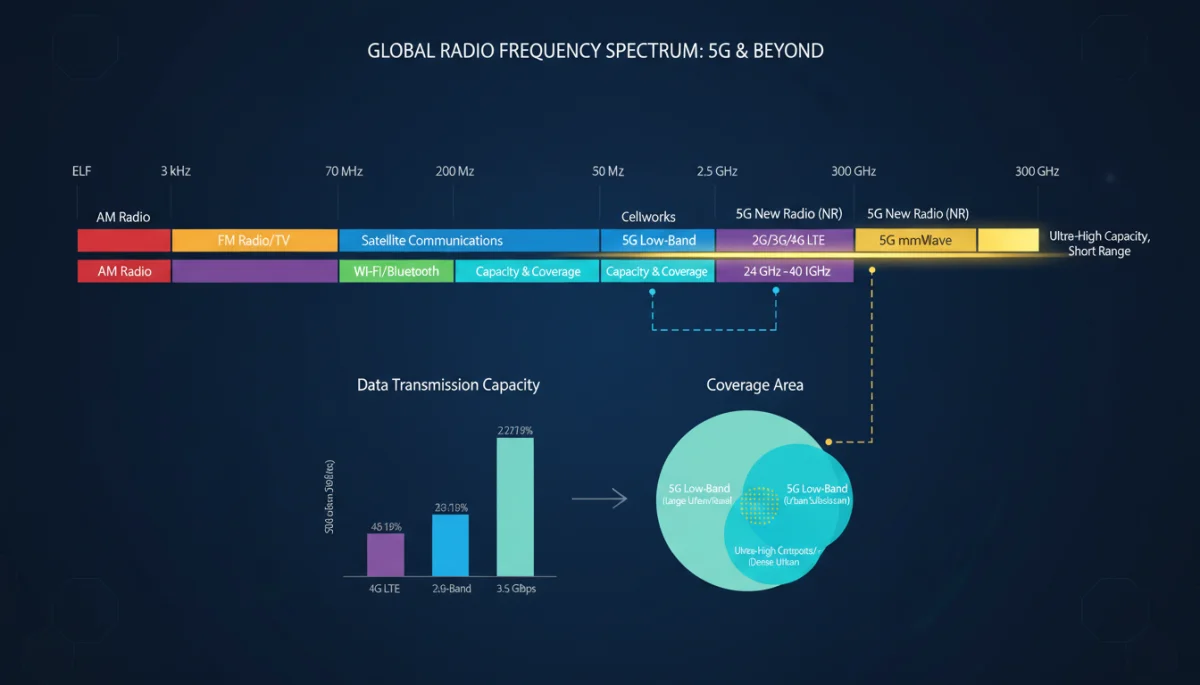
The technical details of these bands, including their bandwidth and specific frequency ranges, will dictate how wireless carriers design and optimize their networks. This involves significant engineering challenges and substantial investment in new infrastructure to fully leverage the potential of the allocated spectrum. The goal is to maximize efficiency and deliver a superior user experience.
Mid-band and high-band spectrum expansion
The Q3 2026 allocations are expected to heavily feature mid-band spectrum, which is widely considered the workhorse of 5G. These frequencies, typically in the 2.5 GHz to 6 GHz range, provide a crucial balance. They can cover larger areas than high-band millimeter wave (mmWave) spectrum while still offering significantly higher speeds and lower latency than low-band frequencies.
Furthermore, there will likely be continued expansion in high-band spectrum (mmWave), which operates at frequencies above 24 GHz. While its range is limited, mmWave offers unprecedented speeds and massive capacity, making it perfect for dense urban environments, stadiums, and other areas requiring extreme bandwidth. The combination of these bands ensures a versatile and powerful 5G network.
- Mid-band: Balances coverage and capacity, ideal for widespread deployment.
- High-band (mmWave): Provides ultra-fast speeds for specific, high-demand areas.
- Low-band: Offers broad coverage, foundational for nationwide reach.
Understanding these technical nuances is key to appreciating the strategic depth of the FCC’s decision. The commission isn’t just opening up new frequencies; it’s carefully orchestrating a spectrum strategy that will enable a truly transformative 5G experience across the United States. This technical foundation is what will underpin future innovations.
Anticipated Benefits for Consumers and Businesses
The FCC’s decision to approve new 5G spectrum allocations for Q3 2026 heralds a wave of significant benefits for both individual consumers and the broader business landscape across the United States. These advantages extend far beyond mere speed increases, touching upon reliability, capacity, and the enablement of entirely new services and applications. This is a strategic move to future-proof the nation’s digital infrastructure.
For consumers, the most noticeable improvements will be in the daily experience of using mobile devices and connected technologies. Imagine seamless streaming of 8K video, virtually lag-free online gaming, and incredibly fast downloads, even in crowded environments. The enhanced capacity means less network congestion, leading to a more consistent and reliable connection wherever 5G is available.
Enhanced mobile broadband experience
The new spectrum will dramatically improve the mobile broadband experience. Users can expect higher average speeds, particularly in urban and suburban areas where mid-band spectrum will be most impactful. This means quicker access to information, more efficient remote work capabilities, and a richer entertainment experience on the go. The shift towards a more robust 5G network will make previous generations of wireless technology feel significantly slower by comparison.
Moreover, the increased capacity will support a greater number of connected devices simultaneously without degradation in performance. This is crucial as more smart home devices, wearables, and IoT gadgets become commonplace. The network will be able to handle the growing data demands of an increasingly connected society, ensuring a smooth and uninterrupted experience for everyone.
New opportunities for industries
Businesses stand to gain immensely from the expanded 5G capabilities. The low latency and high bandwidth offered by the new spectrum will accelerate the adoption of advanced technologies such as artificial intelligence, augmented reality (AR), virtual reality (VR), and the Internet of Things (IoT) in industrial settings. This will lead to significant operational efficiencies and new revenue streams.
- Smart manufacturing: Real-time data processing for automation and quality control.
- Telemedicine: High-definition remote consultations and surgical assistance.
- Logistics and transportation: Enhanced fleet management and autonomous vehicle development.
- Smart cities: Improved traffic management, public safety, and utility services.
The combined impact of these benefits will foster a more digitally integrated and economically vibrant United States. The FCC’s forward-thinking approach ensures that the country remains competitive on the global stage, driving innovation and improving the quality of life for its citizens through superior connectivity.
Challenges and Implementation Hurdles
While the Federal Communications Commission’s approval of new 5G spectrum allocations for Q3 2026 is a cause for optimism, the path to full implementation is not without its challenges. Deploying new spectrum requires significant investment, extensive infrastructure upgrades, and navigating complex regulatory and logistical hurdles. These factors will influence the speed and effectiveness of nationwide 5G expansion.
One of the primary challenges lies in the sheer scale of infrastructure required. Carriers will need to install new antennas, upgrade existing cell sites, and potentially build new towers to fully utilize the allocated bands, especially for mid-band and high-band spectrum which have different propagation characteristics. This is a massive undertaking that demands substantial capital and labor.
Infrastructure deployment and costs
The cost associated with deploying new 5G infrastructure is astronomical. Wireless carriers must invest billions of dollars in equipment, site acquisition, and labor to build out networks capable of leveraging the new spectrum. This includes not only the radio access network (RAN) but also upgrading the backhaul, often requiring extensive fiber optic cable deployment.
Furthermore, the process of obtaining permits for new cell sites can be time-consuming and complex, varying significantly from one municipality to another. These bureaucratic hurdles can delay deployment, impacting the timeline for consumers to experience the full benefits of the new allocations. Streamlining these processes is critical for efficient rollout.
Ensuring equitable access and coverage
Another significant challenge is ensuring that the benefits of new 5G spectrum are equitably distributed across the United States. While urban areas typically see rapid deployment due to higher population density and demand, rural and underserved communities often lag. The FCC and carriers face the task of bridging the digital divide.
- Rural connectivity: Strategies are needed to extend 5G to less populated areas.
- Affordability: Ensuring services remain affordable for all income levels.
- Digital literacy: Programs to educate communities on using new technologies.
- Infrastructure sharing: Exploring options for shared infrastructure to reduce costs in sparse areas.
Addressing these challenges requires a concerted effort from government, industry, and local communities. While the spectrum allocation is a crucial first step, sustained commitment to infrastructure development and equitable access strategies will be vital to realize the full potential of 5G across the nation.
The Future Landscape of US Telecommunications Post-2026
Looking beyond Q3 2026, the Federal Communications Commission’s approval of new 5G spectrum allocations is set to profoundly reshape the future landscape of US telecommunications. This strategic move is not merely about incremental improvements; it’s about laying the groundwork for a new generation of digital services and economic opportunities. The post-2026 era promises a more connected, efficient, and innovative nation.
The enhanced 5G networks will serve as the backbone for emerging technologies, from advanced artificial intelligence applications to widespread adoption of the Internet of Things (IoT). We can anticipate a surge in innovation across various sectors, leading to new business models, improved public services, and a more integrated digital society. This is an investment in the long-term digital competitiveness of the United States.
Evolution of 5G and beyond
The 2026 spectrum allocations will solidify the foundation for 5G-Advanced and pave the way for 6G research and development. As 5G matures, expect an evolution towards even greater intelligence, efficiency, and integration with other technologies. Features like network slicing, enhanced mobile broadband (eMBB), ultra-reliable low-latency communications (URLLC), and massive machine-type communications (mMTC) will become more prevalent and refined.
The continuous evolution of wireless technology means that today’s cutting-edge will be tomorrow’s standard. The FCC’s forward-looking approach ensures that the U.S. is not just keeping pace but actively shaping the direction of global telecommunications. This commitment to future-proofing the spectrum strategy is vital for sustained leadership in the digital age.
Impact on global competitiveness
A robust and advanced 5G infrastructure is a critical component of national competitiveness. By approving new spectrum, the FCC is strengthening the U.S. position in the global race for technological leadership. This enables American companies to innovate, compete, and export cutting-edge solutions, fostering economic prosperity and national security.
- Technological leadership: Maintaining an edge in wireless innovation.
- Economic growth: Driving new industries and job creation.
- International standards: Influencing global 5G and future wireless standards.
- Digital resilience: Building a robust and secure national network.
The post-2026 telecommunications landscape will be characterized by a seamless, high-performance network that supports an unprecedented level of digital activity. This vision, enabled by strategic spectrum management, will empower individuals, businesses, and government agencies to unlock new possibilities and drive societal progress.
What These Allocations Mean for the Average American
For the average American, the Federal Communications Commission’s approval of new 5G spectrum allocations for Q3 2026 translates directly into a tangible improvement in their daily digital lives. While the technical details might seem complex, the practical impact will be felt in faster, more reliable, and more versatile wireless services. This is about making technology work better for everyone.
Imagine fewer dropped calls, quicker loading times for websites and applications, and the ability to seamlessly use data-intensive services like virtual reality without frustrating lags. These new allocations are designed to alleviate network congestion, especially in urban areas, ensuring that more people can access high-quality connectivity simultaneously.
Improved daily connectivity
The most immediate and widespread benefit will be an overall improvement in daily connectivity. Whether you’re working remotely, streaming entertainment, attending online classes, or simply browsing the web, the enhanced 5G network will provide a smoother and more consistent experience. This is crucial in an increasingly digital world where reliable internet access is no longer a luxury but a necessity.
The new mid-band spectrum, in particular, will significantly boost the coverage and capacity in many areas, meaning fewer dead zones and more consistent speeds indoors and outdoors. This will empower individuals to stay connected and productive, regardless of their location, facilitating everything from navigating traffic with real-time updates to video calling loved ones across the country.
Access to new services and applications
Beyond existing services, the expanded 5G capabilities will unlock a host of new applications and services that are currently in their nascent stages or not yet conceived. This could include more sophisticated augmented reality experiences, truly immersive virtual reality environments, and smart home ecosystems that operate with unprecedented responsiveness.
- Enhanced entertainment: Immersive gaming and high-fidelity streaming.
- Advanced education: Interactive learning platforms and remote labs.
- Smarter living: Responsive smart home devices and connected urban services.
- Personal health: Wearable health monitors with real-time data transmission.
Ultimately, these allocations are about creating a more capable digital infrastructure that can support the evolving needs and aspirations of the American public. The average American will experience a world where their devices and services are more powerful, more reliable, and more integrated into their daily routines, making life more convenient and enriching.
| Key Aspect | Brief Description |
|---|---|
| Spectrum Allocation | FCC approved new 5G spectrum bands for Q3 2026. |
| Benefits | Enhanced speeds, capacity, and lower latency for users. |
| Challenges | Significant infrastructure costs and deployment hurdles. |
| Future Impact | Drives innovation, economic growth, and global competitiveness. |
Frequently asked questions about 5G spectrum allocations
The FCC approved the allocation of new frequency bands for 5G wireless services, specifically slated for deployment and utilization by Q3 2026. This decision aims to enhance network capacity, speed, and overall performance, addressing the growing demand for advanced mobile broadband services across the United States.
You can expect significantly faster download and upload speeds, reduced latency, and more reliable connections, especially in crowded areas. This will lead to smoother streaming, quicker downloads, and improved performance for online gaming and other data-intensive applications. It will also enable new services.
While the allocations are approved for Q3 2026, the full benefits will roll out gradually. Wireless carriers will need time to deploy new infrastructure and upgrade existing networks to utilize the new spectrum. You should start noticing improvements in areas with active upgrades shortly after the 2026 timeline.
One of the FCC’s goals with new spectrum is to improve coverage, including in rural and underserved areas. While urban centers often see initial deployment, the strategic allocation of mid-band spectrum aims to provide a better balance between capacity and coverage, making 5G more viable and accessible in less densely populated regions over time.
Industries heavily reliant on high-bandwidth and low-latency communications, such as manufacturing (smart factories), healthcare (telemedicine), transportation (autonomous vehicles), and entertainment (AR/VR), stand to benefit immensely. These sectors will leverage enhanced 5G for automation, real-time data processing, and innovative service delivery.
Conclusion
The Federal Communications Commission’s approval of new 5G spectrum allocations for Q3 2026 marks a pivotal moment in the evolution of American telecommunications. This decision is poised to deliver a more robust, faster, and reliable 5G experience for consumers and unlock unprecedented opportunities for businesses. While deployment challenges remain, the strategic foresight behind these allocations ensures the United States stays at the forefront of global digital innovation, fostering economic growth and enhancing daily connectivity for all citizens.